
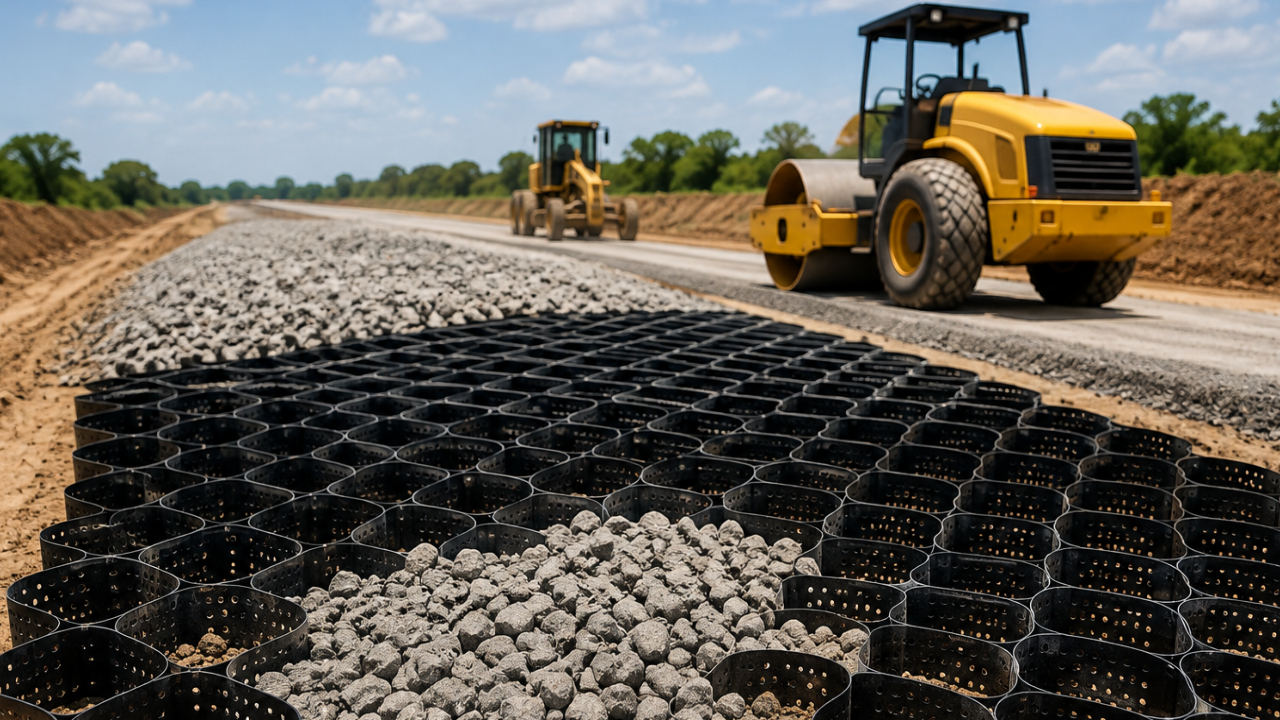
A strong and durable road starts with a strong foundation. But what happens when the road has to be constructed over weak, soft, or unstable soil?
Problems such as rutting, settlement, deformation, and low load-bearing capacity can quickly affect road performance. This is where Geocells can make a significant difference.
Geocells are a three-dimensional geosynthetic solution designed to provide soil stabilization, load distribution, and reinforcement. Commonly manufactured from High-Density Polyethylene (HDPE), geocells form a honeycomb-like cellular structure when expanded. Once these cells are filled with soil, sand, aggregate, or other suitable materials, they create a confined and more stable layer.
What Are Geocells?
Imagine a flexible honeycomb structure placed over the ground and filled with aggregate. That is essentially how a geocell system works.
Geocells are three-dimensional cellular confinement systems used in road construction and other infrastructure applications. Their interconnected cells hold the infill material in place and restrict its lateral movement.
This confinement improves the stability of soil and aggregate, making geocells particularly useful where roads are being constructed over weak or low-bearing-capacity subgrades.
How Do Geocells Improve Road Performance?
Every road is exposed to repeated traffic loads. In a conventional road structure, these loads travel through the pavement and base layers before reaching the underlying soil.
When the subgrade is weak, it may not be able to handle these stresses effectively. Over time, this can result in rutting, settlement, aggregate displacement, and deformation.
Geocells help address this challenge by creating a three-dimensional confinement system around the infill material.
Once filled, the cells:
- Restrict the lateral movement of aggregate
- Improve load distribution across the road layer
- Increase the stability of soil and base materials
- Reduce rutting and deformation
- Improve the overall performance of road layers
In simple terms, geocells help the road structure work more efficiently, especially when the ground underneath is weak.
Where Are Geocells Used in Road Construction?
One of the biggest advantages of geocells is their versatility. They can be used in different layers and applications depending on project requirements.
1. Road Base Reinforcement
Geocells can be incorporated into base or sub-base layers to provide confinement and improve load distribution. This can help create a more stable road foundation capable of handling traffic loads more effectively.
2. Stabilization of Weak Subgrades
Soft and weak soils can create major challenges during road construction. Geocells can form part of an engineered stabilization system that improves the performance of the road over such subgrades by limiting deformation and improving load transfer.
3. Unpaved and Low-Volume Roads
For unpaved roads, aggregate movement can be a major concern. Geocells help keep the aggregate confined within the cellular structure, improving surface stability and reducing material displacement.
4. Road Shoulders
Road shoulders are exposed to traffic movement, water, and erosion. Geocells can help stabilize shoulder materials, reduce aggregate displacement, and improve the overall integrity of the road edge.
5. Slopes and Embankments
Geocells are also useful beyond the road surface. They can be used for slope and embankment stabilization and can support vegetation and other erosion-control measures where required.
Key Benefits of Geocells
Why are geocells becoming an important option for soil stabilization and road reinforcement?
Improved Load Distribution
The three-dimensional cellular structure helps distribute applied loads over a wider area. This can reduce concentrated stresses on the underlying weak soil.
Effective Soil Stabilization
Geocells provide three-dimensional confinement, keeping soil and aggregate in place and improving the stability of the reinforced layer.
Reduced Rutting and Deformation
Traffic can cause aggregate to move laterally, particularly when the underlying soil is weak. Geocells restrict this movement, helping reduce rutting and deformation.
Better Performance on Weak Soil
Where subgrade conditions are poor, geocells can provide additional confinement and stability as part of a properly designed road system.
Durable and Long-Lasting
HDPE geocells offer good durability and resistance to moisture and environmental conditions, making them suitable for a wide range of infrastructure applications.
How Are Geocells Installed?
Good performance depends not only on the geocell material but also on proper installation and project-specific design.
Step 1: Prepare the Site
The construction area is cleared, graded, and prepared according to the project specifications.
Step 2: Prepare the Subgrade
The subgrade is prepared and compacted as required. Unsuitable material may need to be removed, replaced, or treated according to the engineering design.
Step 3: Place and Expand the Geocells
Geocell panels are positioned over the prepared surface and expanded to the required dimensions. They are then secured appropriately to maintain their position.
Step 4: Fill the Cells
The expanded cells are filled with the specified soil, sand, aggregate, or other suitable infill material.
Step 5: Compact the Infill
The infill material is compacted to achieve the required density and stability while maintaining the integrity of the geocell structure.
Step 6: Complete the Road Structure
The required base, sub-base, or surface layer is constructed over the reinforced section according to the approved road design.
Geocell vs Geogrid: What’s the Difference?
Both geocells and geogrids are widely used for soil and road reinforcement, but they work through different mechanisms.
Geogrids are planar reinforcement products that primarily provide tensile reinforcement and help improve the interaction between soil and reinforcement.
Geocells, on the other hand, are three-dimensional systems that provide cellular confinement. They hold soil or aggregate within individual cells and restrict lateral movement.
So, which one is better?
There is no single answer. The right solution depends on factors such as soil conditions, traffic loading, pavement design, project requirements, and site conditions. In some applications, geocells and geogrids may even be used together to achieve the desired performance.
Why Choose Geocells for Road Construction?
When road construction meets challenging ground conditions, simply adding more aggregate may not always be the most efficient solution.
Geocells provide a way to confine, stabilize, and reinforce the material within the road structure. By controlling lateral movement and improving load distribution, they can help the road perform better under repeated loading.
From weak subgrades and unpaved roads to road shoulders, slopes, and embankments, geocells offer a versatile approach to improving ground and road stability.
Conclusion
Road performance depends heavily on what lies beneath it. When the underlying soil is weak or unstable, finding an effective stabilization solution becomes essential.
Geocells provide three-dimensional confinement that can improve load distribution, stabilize aggregate, reduce lateral movement, and minimize deformation. This makes them a valuable solution for a wide range of road and infrastructure applications.
With the right design, material selection, installation practices, and site-specific engineering, geocells can contribute to roads that are more stable, durable, and efficient.
Frequently Asked Questions
What are geocells used for in road construction?
Geocells are used for soil stabilization, road base reinforcement, load distribution, weak subgrade improvement, and unpaved road construction.
Are geocells suitable for weak soil?
Yes. Geocells can be used as part of an engineered stabilization system for weak or soft subgrades, helping improve confinement, load distribution, and overall layer stability.
What are geocells made of?
Geocells are commonly manufactured from High-Density Polyethylene (HDPE), a durable polymer widely used for infrastructure and geotechnical applications.
What is the difference between geocells and geogrids?
Geocells provide three-dimensional confinement to soil or aggregate, while geogrids primarily provide tensile reinforcement. The most suitable option depends on the specific project conditions and design requirements.
Can geocells and geogrids be used together?
Yes. Depending on the project design, geocells and geogrids can be combined to provide both cellular confinement and tensile reinforcement.

Leave a Reply