
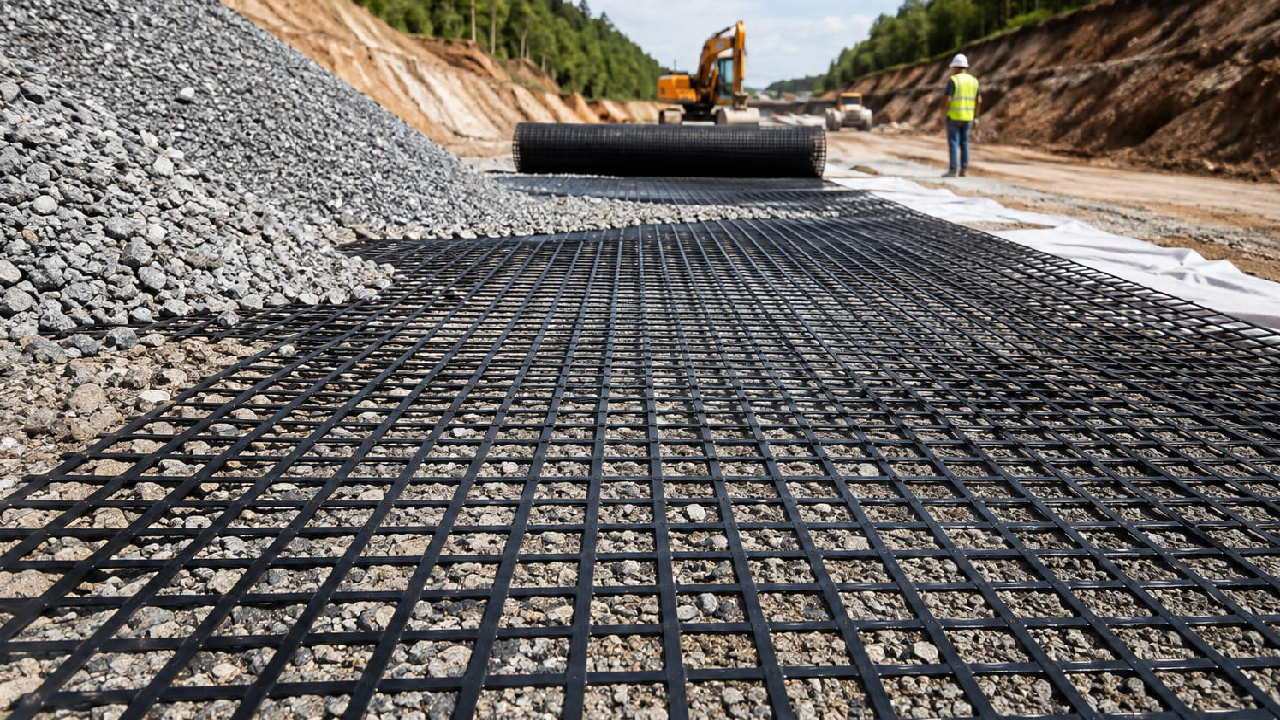
Road construction over weak or unstable soil can lead to problems such as rutting, settlement, cracking, and excessive deformation. Geogrids in road construction are widely used to improve soil stability, reinforce aggregate layers, and enhance the overall performance of road structures.
Geogrids are polymeric geosynthetic materials with an open grid-like structure. They are commonly used in highways, rural roads, access roads, parking areas, and other civil engineering projects where additional reinforcement and load distribution are required.
As an important category of geosynthetics, geogrids primarily provide reinforcement and stabilization. Their open apertures allow aggregate particles to interlock with the geogrid, helping create a stronger and more stable road structure.
What Are Geogrids?
Geogrids are geosynthetic materials generally manufactured from polymers such as polypropylene, polyester, or high-density polyethylene. Unlike geotextiles, which are continuous permeable fabrics, geogrids have a network of ribs and openings known as apertures.
In road construction, geogrids are commonly placed within or beneath aggregate layers and, in some cases, directly over weak subgrade soils. Aggregate particles interact with the geogrid structure, helping reduce lateral movement and improve the stability of the road layers.
This reinforcement mechanism can improve load distribution and reduce deformation under repeated traffic loading.
To learn more about different geosynthetic materials, their types, and applications, read our complete guide on Geosynthetics in Civil Engineering: Types, Benefits & Applications.
Types of Geogrids
The most common types of geogrids used in civil engineering include:
Uniaxial Geogrids
Uniaxial geogrids are designed to provide high tensile strength primarily in one direction.
They are commonly used in applications such as:
- Retaining walls
- Reinforced soil structures
- Steep slopes
- Embankments
Their primary function is to provide reinforcement where forces mainly act in one direction.
Biaxial Geogrids
Biaxial geogrids provide tensile strength in both the longitudinal and transverse directions.
They are commonly used in road construction for:
- Base reinforcement
- Subgrade stabilization
- Aggregate layer improvement
- Load distribution
Biaxial geogrids are useful where traffic loads and stresses act in multiple directions.
Triaxial and Multiaxial Geogrids
Triaxial and multiaxial geogrids are designed to provide reinforcement in multiple directions.
They are commonly used for:
- Road base stabilization
- Working platforms
- Industrial yards
- Heavy-duty pavements
- Weak subgrade areas
Their structure can help improve aggregate confinement and resistance to multidirectional loading.
Functions of Geogrids in Road Construction
Geogrids perform several important functions in road infrastructure.
Reinforcement
The primary function of a geogrid is reinforcement. Aggregate particles interlock with the openings of the geogrid, helping create a more stable composite layer.
This can improve the ability of the road structure to resist deformation under traffic loading.
Aggregate Stabilization
Geogrids help restrict the lateral movement of aggregate particles.
By improving aggregate confinement, they can help maintain the shape and stability of the base or sub-base layer.
Load Distribution
Geogrid reinforcement can help distribute traffic loads over a wider area.
This may reduce stress concentrations on weak subgrade soils and improve the overall structural performance of the pavement system.
Reduction of Rutting
Repeated vehicle loading can cause aggregate movement and permanent deformation.
By stabilizing the aggregate layer, geogrids can help reduce rutting and improve resistance to deformation.
Subgrade Improvement
When roads are constructed over weak or soft soils, geogrids can provide additional support and reinforcement.
They help improve the interaction between the aggregate layer and the underlying subgrade, contributing to better road stability.
Applications of Geogrids in Road Construction
Geogrids are used in various road and infrastructure projects, including:
- Highway construction
- Rural and low-volume roads
- Access roads
- Temporary construction roads
- Road widening projects
- Parking areas
- Industrial yards
- Working platforms
- Airport pavements
- Railway infrastructure
They are particularly useful in projects involving weak subgrade conditions or heavy traffic loading.
Benefits of Using Geogrids
Using geogrids in road construction can provide several benefits:
Improved Road Stability
Geogrids reinforce aggregate layers and help reduce the lateral movement of materials. This can improve the overall stability of the road structure.
Better Load Distribution
The reinforced aggregate layer can distribute traffic loads more effectively over the underlying soil.
This can be particularly beneficial when constructing roads over weak subgrades.
Reduced Rutting and Deformation
Aggregate stabilization can help reduce permanent deformation caused by repeated traffic loads.
This contributes to improved pavement performance and stability.
Potential Reduction in Aggregate Requirements
In suitable applications, geogrid reinforcement may help optimize the required thickness of aggregate layers.
However, the final design should always be based on project-specific engineering requirements.
Increased Service Life
By improving reinforcement and aggregate stability, geogrids can help reduce certain causes of pavement deterioration and contribute to longer-lasting road infrastructure.
Reduced Maintenance
Improved road stability and reduced deformation may help reduce maintenance and repair requirements over the life of the pavement.
Cost Efficiency
In suitable projects, geogrids can help improve construction efficiency and potentially reduce material and maintenance costs.
Geogrid vs Geotextile in Road Construction
Although both materials are important types of geosynthetics, geogrids and geotextiles perform different primary functions.
| Feature | Geogrid | Geotextile |
|---|---|---|
| Main Function | Reinforcement and stabilization | Separation, filtration and drainage |
| Structure | Open grid with apertures | Continuous permeable fabric |
| Aggregate Interaction | Mechanical interlocking | Separation between materials |
| Common Application | Base and sub-base reinforcement | Separation of subgrade and aggregate |
| Primary Benefit | Improved stability and load distribution | Improved separation and drainage |
In many road projects, geogrids and geotextiles can also be used together.
For example, a geotextile may be placed over weak subgrade soil to provide separation and filtration, while a geogrid may be used to reinforce and stabilize the aggregate layer.
Factors to Consider When Selecting Geogrids
Choosing the right geogrid is important for successful project performance. Key factors include:
- Subgrade soil strength
- Traffic loading
- Aggregate type and particle size
- Geogrid aperture size
- Tensile strength
- Junction strength
- Durability
- Installation requirements
The appropriate geogrid should always be selected according to the specific engineering and design requirements of the project.
Geogrid Installation in Road Construction
A typical geogrid installation process includes:
- Preparing and leveling the subgrade surface.
- Removing unsuitable materials, vegetation, and debris.
- Unrolling and placing the geogrid over the prepared surface.
- Providing the required overlap between adjacent sections.
- Ensuring the geogrid remains properly positioned during aggregate placement.
- Placing aggregate carefully to avoid damaging or displacing the geogrid.
- Spreading and compacting the aggregate according to project specifications.
- Constructing the remaining pavement layers as required.
Proper installation is essential to achieve effective interaction between the geogrid and aggregate materials.
Conclusion
Geogrids in road construction provide an effective solution for reinforcing aggregate layers, improving load distribution, and increasing the stability of road structures.
They are widely used in highways, rural roads, access roads, parking areas, working platforms, and other infrastructure projects, particularly where weak subgrade conditions or heavy loading create construction challenges.
By selecting the right type of geogrid and following proper design and installation practices, engineers can improve pavement performance, reduce deformation, and support longer-lasting infrastructure.
Geogrids are therefore an important part of modern geotechnical engineering and a valuable solution for many road construction and soil stabilization challenges.
Also read: Geotextiles in Road Construction: Types, Benefits, Applications & Installation to learn how geotextiles help improve separation, filtration, drainage, and protection in road projects.

Leave a Reply