
Introduction
Modern civil engineering projects often require structures to be constructed in challenging ground conditions, limited spaces and areas exposed to significant loads. Reinforced soil systems provide an alternative approach for improving the stability and performance of soil structures.
Geostraps are polymeric strip-type geosynthetic reinforcement products used to reinforce soil in applications such as retaining walls, reinforced embankments and other geotechnical structures. India’s Bureau of Indian Standards lists IS 17372:2020 for polymeric strip/geostrip used as soil reinforcement in retaining structures.
M2M Engineering offers Geostrap solutions designed for infrastructure applications including road and railway base reinforcement, retaining wall facings, slope and channel protection and load support in weak soils.
What Is a Geostrap?
A Geostrap is a strip-shaped geosynthetic reinforcement element designed to provide tensile reinforcement within a soil structure.
Unlike conventional soil, which has limited tensile resistance, geosynthetic reinforcement introduces tensile elements into the reinforced soil mass. When correctly designed and installed, these reinforcement elements interact with the surrounding soil and contribute to the stability of the overall system.
M2M’s Geostrap description specifies closely packed high-tenacity polyester yarns encased in an LLDPE sheath and manufactured through a co-extrusion process.
How Does Geostrap Reinforcement Work?
The basic principle is relatively simple.
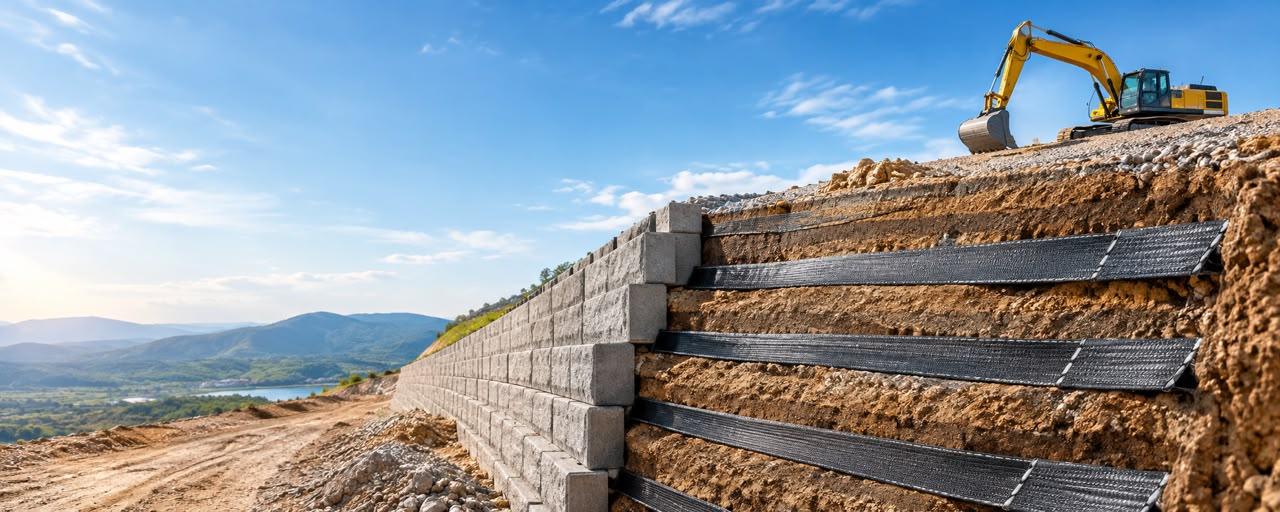
Geostraps are installed within selected layers of compacted fill. As the soil mass is subjected to loading, interaction between the reinforcement and surrounding soil develops resistance against deformation.
This reinforcement can help control lateral movement within the soil mass and contribute to the stability of reinforced structures.
FHWA describes reinforcement functions of geosynthetics in terms including lateral restraint, increased bearing capacity and, in certain situations, membrane tension support.
The actual reinforcement mechanism and required reinforcement arrangement depend on soil properties, loading, geometry, connection details and project-specific design.
Where Are Geostraps Used?
Geostraps can be used in a range of civil and infrastructure applications.
1. Reinforced Soil Retaining Walls
One of the important applications of strip reinforcement is reinforced soil retaining structures.
Geostraps can be placed in horizontal layers within the reinforced soil mass and connected to the selected facing system. This creates a reinforced soil structure capable of resisting the forces acting on the wall system.
Proper connection design is particularly important because the reinforcement must transfer forces effectively between the soil mass and facing.
2. Embankments
Geostraps can be considered for reinforced embankments where additional tensile reinforcement is required.
They may be useful where construction geometry, available right-of-way or soil conditions create challenges for conventional earth structures.
3. Roads and Railways
Geosynthetic reinforcement is widely used in transportation infrastructure. FHWA identifies geosynthetics as materials used in pavement systems and for reinforcing embankments and foundation soils.
M2M lists road and railway base reinforcement among Geostrap applications.
4. Slope Stabilization
Geostrap reinforcement can also form part of engineered slope stabilization systems. The reinforcement arrangement must be designed according to slope geometry, soil parameters, groundwater conditions and expected loads.
5. Weak Soil Load Support
Where soil has limited strength, reinforcement can be incorporated into the ground-improvement system to improve structural performance.
However, the selection of reinforcement should always be based on geotechnical investigation and engineering design rather than assuming that one product specification will suit every soil condition.
Key Benefits of Geostrap
Depending on the application and design, Geostrap systems can provide several benefits:
- Tensile reinforcement within soil structures
- Efficient interaction with surrounding soil
- Suitable for reinforced soil structures
- Adaptable to different wall and embankment configurations
- Relatively easy handling and installation
- Potentially reduced structural footprint compared with some conventional solutions
- Suitable for infrastructure and geotechnical applications
M2M specifically lists reduced maintenance requirements, quick installation, improved load-bearing capacity and environmental considerations among the benefits of its Geostrap product range.
Geostrap vs Conventional Reinforcement
Traditional retaining and earth-support systems may rely heavily on reinforced concrete, masonry or other structural systems.
Geosynthetic reinforcement provides another approach: rather than treating the soil simply as a load acting on a separate retaining structure, reinforcement can be incorporated directly into the soil mass.
The appropriate solution depends on site conditions, design requirements, construction methodology, available space, drainage and project economics.
Factors to Consider Before Selecting a Geostrap
Engineers should consider:
- Required tensile strength
- Soil type and properties
- Reinforced soil geometry
- Facing system
- Connection strength
- Installation conditions
- Design life
- Chemical and environmental exposure
- Drainage conditions
- Expected static and dynamic loading
Reduction factors for installation damage, creep and degradation are important considerations in geosynthetic reinforcement design. FHWA guidance discusses these factors when determining allowable long-term reinforcement strength.
Conclusion
Geostrap is an important type of geosynthetic reinforcement for applications where soil needs additional tensile reinforcement and structural stability.
From retaining walls and embankments to transportation infrastructure, Geostrap systems can be incorporated into engineered reinforced-soil solutions.
The key to successful performance is not simply choosing a high-strength product. The reinforcement type, strength, spacing, connection and installation arrangement should all be selected according to the project’s geotechnical and structural requirements.
For project-specific Geostrap requirements, M2M Engineering provides geosynthetic solutions for infrastructure and soil-reinforcement applications.

Leave a Reply